Friday, May 13, 2011

Rising Cost of Fuel

Rising Cost of Fuel Drawing Fire from Industry Leaders

Trucker to Trucker is the premier online resource for buying and selling trucks and equipment and trucking related services. Today, we are looking at senior industry reaction to the rising cost of fuel:
Bill Graves, the CEO and President of the American Trucking Association, told members of the House Natural Resources Committee on March 31, 2011, that in order to allow affordable diesel fuel to the trucking industry, policymakers would have to step up.

In his written statement, Graves stated that there was no one way to solve the problem of high oil prices, that conservation and more drilling combined was the only way to relieve the issue.  He told the committee that the trucking industry will likely use 35 billion gallons of diesel fuel and will spend $135.8 billion dollars this year.  He noted that in 2010, the industry only spent $100.8 or so billion on fuel, and that the spike in cost has impacted the trucking industry negatively, causing them to raise their prices to pay for the more expensive fuel, and in some cases, to shut down.

Graves stated also that the new national speed limit of 65 miles per hour is not enough to cut the fuel prices.  While the speed limit increase does make the trucks more productive, there is still not enough fuel in supply to lower the cost.  In essence, Graves proposes that Congress take action to increase the U.S.’s production of crude oil here on the home front and that Congress should also urge the Obama administration to promote oil shale and coal-to-liquid and gas-to-liquid fuels, and should issue more permits for drilling in the Gulf of Mexico.

Graves also criticized the government for failing to promote the development and growth of heavy duty vehicles that are powered by natural gas.  He says that the natural gas trucks cost twice what diesel powered trucks cost, so a tax credit might be necessary in order to allow companies to purchase these types of vehicles.
Finally, Graves suggests that Congress should place an incentive on LNG refueling station standardization – weight increases are assured with LNG (liquefied natural gas) trucks and that if there was a federal gross vehicle weight limit variance in place, companies would be more likely to adopt the LNG switchover.

Tuesday, April 5, 2011

White House Launches National Clean Fleets Partnership

White House launches National Clean Fleets Partnership

Published April, 04 2011
President Obama on Friday, April 1, announced the National Clean Fleets Partnership, a public-private partnership to help commercial vehicle fleets reduce diesel and gasoline use by sourcing electric vehicles, alternative fuels and fuel-saving measures into their daily operations. Through the partnership, the Department of Energy will assist companies in their efforts to reduce fuel use and achieve greater efficiency and cost savings by offering specialized resources, technical expertise and support. The partnership is part of the DOE Vehicle Technology Program’s Clean Cities initiative and will complement the U.S. Environmental Protection Agency’s SmartWay program by furthering efforts to improve efficiency in goods movement and reducing U.S. dependency on foreign oil.
The partnership includes five charter members representing some of the nation’s largest fleets with a collective 275,000 vehicles: AT&T, FedEx, PepsiCo, UPS and Verizon. According to the White House, their planned petroleum reduction strategies will account for the deployment of more than 20,000 advanced technology vehicles and annual petroleum displacement in excess of 7 million gallons.
As part of the announcement, DOE challenged other companies to join the effort. Participating companies will benefit from technical assistance, including peer-to-peer information exchange and collaboration with DOE and national laboratories surrounding research and development initiatives. In addition, group purchasing also will be available so that smaller companies can work with their larger peers to get the benefits of purchasing advanced vehicles in bulk.
The National Clean Fleets Partnership followed the president’s announced goal two days earlier of cutting America’s oil imports amount by one-third by 2025. The White House identified large commercial fleets as a key opportunity to reduce oil imports, “which with the proper incentives can offer significant potential reductions in fuel use,” according to a White House statement.
“Though many hurdles still remain and the path to success will not be easy, the sustainable business benefits of alternative fuels cannot be underemphasized,” said Scott Davis, UPS chairman and chief executive officer. “We must deal with the short-term problems of cost differentials and infrastructure to prepare for our long-term future.”

Friday, February 18, 2011

Mack Truck comes to CBS reality TV

Class 8 trucks come to CBS reality-TV series Undercover Boss this weekend, featuring Mack Trucks President and CEO Denny Slagle. The broadcast will be from 9-10 p.m. Sunday, Feb. 20, Eastern and Pacific.

In making the episode, as with others in the series, the company president went undercover to work side-by-side with Mack employees at the Macungie, Pa., plant that assembles every Mack truck sold in North America; the Hagerstown, Md., plant that produces every Mack engine sold in North America; and the Baltimore, Md., distribution center that provides parts to Mack dealers and customers

Thursday, February 3, 2011

FMCSA proposes to mandate EOBRs

FMCSA proposes to mandate EOBRs

January 31, 2011

 | by: Avery Vise

All interstate commercial truck and bus carriers that now use logbooks to track compliance with hours-of-service regulations would have to use electronic onboard recorders (EOBRs) instead under a proposed regulation issued by the Federal Motor Carrier Safety Administration on Jan. 31.
The proposal would relieve carriers of the current requirement to retain certain HOS documents, such as delivery and toll receipts, that are now used to verify the number of hours the vehicle is in operation. Approximately 500,000 carriers would be affected by the proposed rule, FMCSA said.

Last year, the U.S. Court of Appeals for the District of Columbia ordered FMCSA to issue a notice of proposed rulemaking (NPRM) on HOS supporting documents by yearend. In December, the court gave the agency another month — until Jan. 31 — to comply. The court order stemmed from a lawsuit the American Trucking Associations filed just over a year ago to compel FMCSA to move forward with a regulation as mandated by Congress in the mid-1990s.
By the time ATA filed its lawsuit, FMCSA had already announced that it was planning to link new regulations on supporting documents to an expansion of the EOBR mandate. In April 2010, FMCSA issued a final rule requiring carriers that have a history of serious log violations to install EOBRs. That rule takes effect in June 2012.
“We cannot protect our roadways when commercial truck and bus companies exceed hours-of-service rules,” Transportation Secretary Ray LaHood said yesterday. “This proposal would make our roads safer by ensuring that carriers traveling across state lines are using EOBRs to track the hours their drivers spend behind the wheel.”
Interstate carriers that currently use records of duty status (RODS) logbooks to document drivers’ HOS would be required to use EOBRs. Short-haul interstate carriers that use timecards to document HOS would not be required to use them. Carriers that violate this EOBR requirement would face civil penalties of up to $11,000 for each offense. Noncompliance would also negatively impact a carrier’s safety fitness rating and DOT operating authority.
“This proposal is an important step in our efforts to raise the safety bar for commercial carriers and drivers,” said FMCSA Administrator Anne Ferro. “We believe broader use of EOBRs would give carriers and drivers an effective tool to strengthen their HOS compliance.”
The Owner-Operator Independent Drivers Association saw it differently. “EOBRs are nothing more than over-priced record keepers,” said Todd Spencer, executive vice president of OOIDA. “This proposal is actually another example of the administration’s determination to wipe out small businesses by continuing to crank out overly burdensome regulations that simply run up costs.”
 
The organizations said EOBRs cannot accurately and automatically record a driver’s hours of service and duty status. They can only track the movement and location of a truck and require human interaction to record any change of duty status. Therefore, such as in the case of loading and unloading time, the device is incapable of determining the actual duty status of drivers without interaction from drivers indicating to the device that they are on-duty. Loading and unloading time should typically be logged as “on-duty, not driving” in order to accurately reflect the hours a driver has worked.
For more information, go to http://regulationroom.org/.

Friday, January 14, 2011

Freight index fell 0.3% in November

The Freight Transportation Services Index fell 0.3 percent in November from October, after increasing the two previous months, the U.S. Department of Transportation’s Bureau of Transportation Statistics reported Jan. 12. 
     
BTS reported the Freight TSI has increased in 14 of the last 18 months. Through the first 11 months of 2010, the index declined 1.0 percent. For additional historic data, go to www.bts.gov/xml/tsi/src/index.xml.
     
The November Freight TSI of 98.5 is down 12.7 percent from its peak of 112.9 in May 2006.

The Freight TSI measures the month-to-month changes in freight shipments in ton-miles, which are then combined into one index. The index measures the output of the for-hire freight transportation industry and consists of data from for-hire trucking, rail, inland waterways, pipelines and air freight.

Friday, December 31, 2010

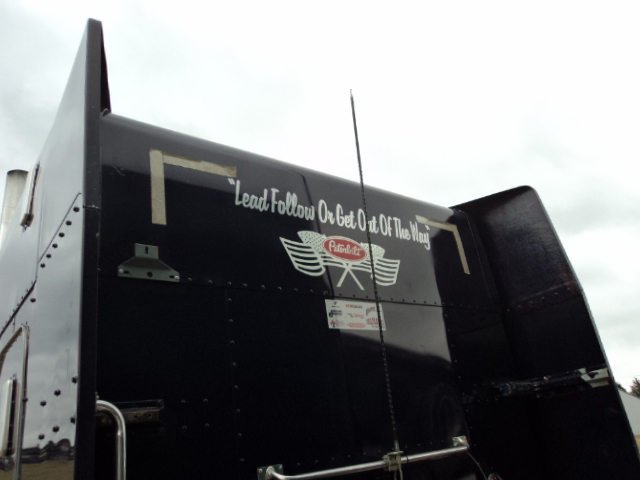
TNT's Peterbilt

Thought we would share some photos of our Peterbilt.  Our driver takes pride in his rig!  He has personalized it with all kinds of chicken lights, chrome and polish!  His name is Jeff Owens and if you see him on the road post it on our Facebook page. !  By the way, we can deliver your trailer purchase...contact one of our sales reps if interested 636-451-2100.


Wednesday, December 22, 2010

Growth in" goods" sector of economy strengthening truck freight

The slow-to-recover economy can be explained as the tale of two phases, GDP growth and truck freight growth, according to analysts with FTR Associates. The GDP rose rapidly, then has slowed because there is less consumer consumption compared to earlier recessions. Senior analyst Neil Perry said tight credit, a slow-to-recover housing market (which accounts for 15 percent of the economy) and unemployment are hampering economic recovery. Growth is still occurring, particularly in the rise of durable goods spending and thanks to global economies like China and
emerging economies such as Brazil, Russia and India. FTR Associates said what will be the main holdup for trucking is conservative equipment replacement, which is expected to continue given the freshness of the downturn for many businesses.

Economy Recovering Stronger in Freight Than Other Areas
Analysts with FTR Associates took great pains to delineate the difference between GDP and truck freight growth in the current economic recovery during the transportation-forecasting firm’s latest Freight Focus webinar held yesterday. Noel Perry, senior consultant at FTR Associates and principal of Transport Fundamentals, pointed out that while certain “structural reasons” explain why the economic recovery overall will be slow, the “strength of the goods side of the economy has [already] made this a strong freight recovery.”
Perry said the “slow recovery on now is expected by most economists to continue.” He explained that GDP growth “accelerated rapidly” but then slowed over the last three quarters—staying below 3% growth. A key reason that growth slowed is because consumption (of goods and services) has been weak so far compared to earlier recessions.