Tuesday, October 30, 2012

Brake-related OOS Violations in 15.3 Percent Vehicles During Safety Week 

At least one in seven vehicles chosen for inspection during the recently held Brake Safety Week had brake-related out-of-service (OOS) violations. The inspections were conducted by commercial vehicle inspections who participated in the week-long annual program. The program includes an enforcement and education campaign that focuses on regulatory compliance of bus and truck brake system maintenance.

Nothing Special
Commercial Vehicle Safety Alliance (CVSA) is the official sponsor of the event. CVSA stated that the violation rates were comparable to recent years, but have edged up slightly for a second consecutive year. The rate of violations is lower than in 2007 and 2008, but slightly higher than the period between 2009 and 2011.
By the Numbers
The OOS rates for inspections in the U.S. were higher than in Canada, which is consistent with earlier results. 10.8 percent of the vehicles in Canada were placed OOS for brakes, compared to 15.3 percent in the U.S. On the parameter of brake adjustment, 9.6 percent of vehicles in the U.S. were placed OOS for poor brake adjustment during the Safety Week, compared to 5.5 percent in Canada.
Not Good Enough
Stephen A. Keppler, Executive Director of CVSA, said: “Commercial vehicles with OOS violations are considered imminent hazards to highway safety. Stopping distances of trucks and buses are longer than passenger cars and they increase significantly with many of the brake violations found during these inspections. The good news is that eight of 10 trucks were compliant, however, the slight increase in out-of-service violations is troubling. Our goal is safe vehicles, drivers, and roadways. We will not tolerate anything less than 100 percent compliance with the safety rules of our roads.”
Safety is Paramount
CVSA members conduct nearly four million safety inspections in a year. The comprehensive North American Standard Level I inspection includes the inspection of brakes always. Brake Safety Week is a part of CVSA’s Operation Airbrake Program conducted in association with U.S. Department of Transportation. Anne S. Ferro, an FMCSA Administrator, said: “Bad brakes on a large truck or bus are a danger to all motorists. Brake Safety Week is a timely reminder for those who cut corners on brake safety that we are watching.”

Thursday, October 18, 2012

GET TO KNOW TNT SALES STAFF:

Boyd A. Benkelman


Boyd A. Benkelman is the Director of Nationwide Expansion for TNT Sales. Boyd has been with TNT Sales for over two years. He has spent most of his career in sales with majority of it in promotional and mortgage sales.

Boyd is in charge of growing the acquisition and sales of used equipment by sourcing and electronic consignment. His first priority is to source used trailers for TNT stock inventory though outbound marketing. Second priority is to “data mine” to collect mailing and email addresses so we can keep in touch and promote the sales of our inventory. He is also responsible to market and sell the trailers that are sourced and not bought by TNT Sales for stock. Lastly he is responsible to expand and improve upon our current marketing efforts. This is done through social networking.

Boyd was born and raised in St. Louis MO and has two daughters.

So if you have a trailer or trailers you would like to sell please contact Boyd at 877-353-2962 or boyd.tnt@gmail.com

Friday, October 12, 2012

Meet the owner of TNT Sales


Meet the owner.


Bill Weiss is the sole owner of TNT Sales with over 20 years experience in the semi trailer industry.  He is living proof that as a American you have opportunity to start out as a basic mechanic and work your way up to owning a multimillion corporation. 


Bill joined the United States Marine Corps on his 17th birthday and after graduating Mehlville High School later that year went on to serve 5 years as a jet mechanic.  After leaving the Corps he could not find work as a jet mechanic so he took a job at Fruehauf Trailer Corp in St. Louis MO as a Apprentice Mechanic.  With a solid work ethic and a desire for his employer to succeed Bill proved himself to be a valuable employee and earned the recognition of the Fruehauf Management.  In less than a year he was promoted to a journeyman mechanic and in that same year was given a sales opportunity when one of the veteran salesmen left for another job.  Bill quickly adapted to sales and within his first full year as a salesman was in the top ten of all Fruehauf salesmen, over 100 at the time.  Each year after Bill was in the top five with at least one year ending the #1 Salesman at Fruehauf Trailer Corp.


While at Fruehauf their Los Angeles branch was struggling because of lack of trailer sales.  Bill was sent to that branch and was able to turn it around into a profitable location for Fruehauf.  During that same period of time Fruehauf was purchased by Wabash National and Bill decided that he would not be a good fit for their culture and moved on to Transcraft Corporation as their National Sales Manager.


Under Bills leadership at Transcraft, Bill grew the market share of Transcraft from around 20% to over 40%.  He was instrumental to the introduction of the Eagle II and implementation of sales programs that encouraged their dealer network to stock trailers and capture more fleet sales.  Bill had personally helped the dealer network close hundreds of new trailer deals resulting in thousand of new trailers to be built.  Additionally Bill had introduced the leadership of Wabash National to Transcraft and through that relationship Transcraft began to build Wabash flatbeds and drop decks under a private label agreement.  That relationship ended when Wabash National bought out Transcraft and they are a wholly owned subsidiary of Wabash today. 


After leaving Transcraft Bill was the National Sales Manager for Manac Trailer USA’s Oran plant which was purchased from CPS Trailers.  Manac introduced and started to build the all aluminum flatbed at that plant.  It was Bill’s responsibility to get that product out to the US market focusing on owner operators and fleets.  During that time Bill had landed the largest single order of all aluminum flats sold to CRST. 


During his years in manufacturing with Transcraft and Manac Bill realized that he missed the retail aspect of trailer sales.  He left Manac and with the help of Great Western Leasing out of Los Angeles CA opened a retail branch for them in St. Louis, ironically in the old Fruehauf branch which had gone out of business.  They were a great help and were a growing company in trailer sales and leasing.  Bill had a desire to do more than just trailer sales and leasing.  He wanted to be a full service dealership with trailer repair and parts sales.  That was not a direction that Great Western wanted to go so in July of 2004 Bill incorporated and TNT Sales was born.


TNT Sales started out in Bill’s home office and was joined by Charlie Blyth as his first employee and salesman.  Quickly the home office was too small for the two of them and they rented a office and small yard in a strip mall not far from Bills home.  At that office we added 3 more sales people and started the repair business with three mechanics. 


The strip mall office quickly was outgrown and TNT Sales move to Villa Ridge MO where we are today.  Since moving to Villa Ridge we have acquired three properties (two shop’s and one yard with the sales office).  We have more than 25 full time employees now with a full service shop, parts department, rental fleet and of course trailer sales. 


TNT Sales represents 9 different new trailer lines, Manac, Fontaine, Dorsey, Doonan, Chaparral, XL Specialized, Talbert, Vantage and Trailmobile.  We are a top dealer for Manac and Fontaine selling over 500 new trailers this past year.  We also are one of the Midwest’s largest used trailer dealer selling over 1,000 used trailers this past year.  We specialize in flatbeds, drop decks, curtain sides, low boys, RGN’s, combine RGN’s and all other types of semi-trailer.


Bill’s philosophy has always been to make sure that the customer is treated in a fair and respected manner.  If we sell you a used trailer and there is a problem we did know about we have always fixed it or offered to buy the trailer back.  We do things different here at TNT Sales.  If you buy a used trailer off of our Villa Ridge yard it has been through our shop.  It will be safe, functional and look as new as a used trailer can.  We do what it takes to give you the best looking used trailer so that your image is upheld with good looking used equipment.


If new is more your speed we try to stock the trailer that you would need.  We have hundreds of new trailers on order and in stock including all aluminum flats and drops, combo flats and drops, stretch flats and drops, mechanical and hydraulic RGN’s.  Just about every type of platform oriented trailer that you could need.


We are here for you.  We want your trailer buying experience to be a pleasant one and that you have confidence with the product that you pull.

Tuesday, October 2, 2012

New Trailers on the Ground

We have the trailers on the ground available now. Please contact me at phone number below.

Boyd Benkelman
636-451-2100


(6) NEW 2013 Manac 53'-72' tri-axlesteel drop decks, fixed air ride, tridem, 60" spread, double pipe spools, pull plates between uprights of bumper, winch track on driver's side, LED lights, 22.5 tires on steel wheels. FOB Champlain NY or Montreal Quebec Canada 19,200# +/-3%.


(10) Now (5) later this month NEW 2013 Fontaine Infinity TX Twist lock drop decks! 53 x 102, aluminum rear, sides and floor with (4) Apitong wood nail strips, 10' front deck with 18" king pin, (16) pair of chain ties in floor, 122" widespread air ride with a rear axle slide, trailer is CA legal in the forward position, LP 22.5 on outside aluminum wheels, rear axle dump, winch track both sides with (12) sliding winches, spare tire carrier, (4) pair of twist locks to carry two 20' containers or one 40' container, 12,284#'s. FOB Villa Ridge MO and Haleyville AL.


(11) Now (6) later this month NEW 2013 Fontaine Infinity 53 x 102 air ride flatbeds! Aluminum front, rear, sides and floor with (4) Apitong nail strips, (22) pair of pop up chain ties, 122" widespread air ride that is CA legal in the forward and closed position, road side winch track with (12) sliding winches, rear axle dump valve, LP 22.5 on outside aluminum wheels 10,854# +/- 3%. FOB Villa Ridge MO and Haleyville AL.


(2) Now (3) Later this month New 2013 Dorsey 48 to 80 S-T-R-E-T-C-H flats! All steel construction with 24" king pin, 6" structural "C" channel side rail, crossmembers on 12" centers, Apitong floor, Hutch spring ride slider, 11 R 22.5 on steel disc wheels, drivers side winch track with 12 sliding winches, LED lights, double pipe spools, stake pockets front and rear. FOB Elba AL.

Tuesday, January 31, 2012

Natural Gas Conversion

Many Trucking Companies Testing Natural Gas Conversion

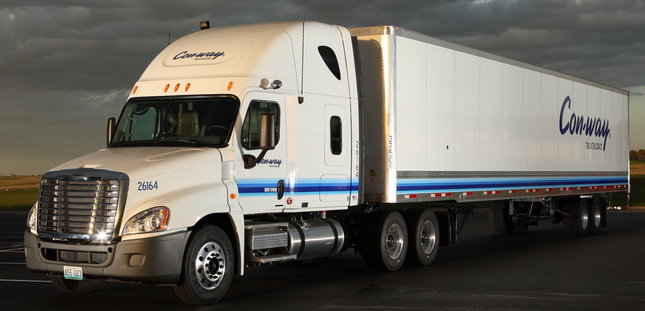
The high price of diesel has many trucking companies looking for cheaper option when it comes to fuel. There are many obstacles in the short-term, but companies such as Wal-Mart and United Parcel Service are converting a small percentage of their vehicles to natural gas as a way to test the feasibility of switching over their fleets completely. Con-Way Freight is launching a program this spring to convert two of their Chicago area trucks to run on compressed natural gas instead of diesel fuel. They chose the Chicago area as their test market because CNG is available there, while it is not widely available in other parts of the country. Con-Way spokespeople said that the company will likely convert more of their trucks if the test is successful.
Reasons Companies are Considering Natural Gas
Cost savings is the number one reason that companies are considering the move to liquefied natural gas or CNG. The current price of CNG is around one dollar per gallon, while diesel costs around $3.39 per gallon. The price of LNG is about one dollar per gallon less than diesel, but the price fluctuates just like all fuel products. Experts estimate that the price of natural gas is especially low right now because the mild winter has lessened demand. The price will likely increase with increased consumption.
Another reason that companies are considering the conversion is that trucks that are fueled by natural gas are significantly quieter than those fueled by diesel. The noise of diesel trucks has prompted many cities across the United States to enact laws to reduce the amount of time truckers are allowed to idle their vehicles.
Obstacles to Converting Semi Truck Fleets to Natural Gas Fuel
The cost of converting vehicles to natural gas from diesel is a significant obstacle in the race toward conversion. It currently costs about $65,000 more for a company to purchase a truck that runs on LNG than a similar model that runs on diesel fuel. The economy has caused many companies to tighten their belts, and most are unwilling to make such a large investment upfront. The cost of buying a truck that runs on CNG is less, at about $30,000 more than a standard diesel truck, but still a large investment.
Trucking companies are also unsure about the costs to maintain a natural gas powered engine versus a diesel powered engine. Cummins is expected to release an LNG powered engine this year that will be priced similarly to a diesel engine, making the choice to convert an easier decision for companies.
The other main reason that trucking companies are apprehensive about converting their fleets is the lack of LNG and CNG fueling stations in most areas of the country. Clean Energy Fuels Corporation, an alternative fuels company, is building 70 LNG stations in 2012 and is planning to open another 80 stations in 2013. They are building these stations along some of the busiest truck routes in the United States, about 250 to 300 miles apart so that trucks running on LNG can be fueled easily. Clean Energy is working with Flying J and Pilot to add LNG pumps at existing truck stops throughout the country.
It is likely to be years before there is a significant increase in the number of trucks on the road powered by LNG or CNG rather than diesel, but more companies are expected to experiment with alternative fuels in the coming years. The availability of LNG powered engines is likely to increase over the next five to ten years, and tax credits have been proposed for companies who switch their fleets to LNG.

Friday, December 23, 2011

Cellular Phone Rulings

CMV Drivers Don’t’ Touch That Cell Phone Before Reading This 

The Ban
The Federal Motor Carrier Safety Administration’s, FMCSA, “Drivers of CMVs: Restricting the Use of [Handheld] Cellular Phones” ruling will be put into effect starting January 3, 2012. The ban is an industry wide ban on the use of all handheld cell phone devices and only carriers exempt from Missouri federal rulings will remain unaffected. Also, this new ruling will carry stiff penalties for drivers and any carriers who allow their drivers to violate the ban. The ban is not just while drivers are on the roadways, but also while sitting in traffic and even stopped at stop lights or signs.
The ban has been labeled as a severe traffic violation and the fines and penalties reflect as much. For each violation of the new ruling, truck drivers will be facing federal civil fines as high as $2,750. A second or third violation within a three year time frame will result in a 60 to 120 day CDL disqualification. In addition, the driver and the carrier’s CSA scores will be affected by any conviction of the ruling. Carriers will face an $11,000 fine for knowingly allowing their drivers to use handheld phones while operating their equipment. The complete ruling can be found here:  http://www.gpo.gov/fdsys/pkg/FR-2011-12-02/html/2011-30749.htm.
The Reactions
Coming on the heels of the new CSA rules, many drivers feel this is yet another FMCSA ruling targeting drivers just to extract more fines from their pockets. The ruling was said to have been based on research and was enacted for safety issues, but most drivers use their CB far more than a cell phone yet CB radios were not included in the ban. This has left drivers asking why. Will Smith, a company long haul driver said, “If this was to reduce distracted drivers by banning the use of their hands to hold a phone, why not ban CB radio use while driving? We use our hands constantly to push and hold the key-up button on the mic.” A ban on CB communication while driving would prove too counterproductive as most drivers rely on it for road conditions and such. Also, there is no need to avert the eyes from the road to use a CB as with cell phones.
The few civilians aware of the new ruling feel a sense of relief knowing that the big rigs and busses they share the roadways with will now be even that more focused. They were pleased to learn a ban against texting for CMV drivers had already been enacted and this just adds to their peace of mind. However, most people outside of the industry are unaware of the ruling.
The Allowable
CMV drivers are allowed to use hands free cell phone devices and headsets. However, there are limitations and restrictions on these too. Drivers cannot reach for their phones, dial them or even hold them as long as they are driving or in the roadway at all. So, to be able to dial out while operating a CMV the phone must be equipped with one touch calling and/or voice activated dialing. Therefore, the use of headsets or a hands free system, such as the type that work through the speakers are mandatory for phone usage to avoid a citation and hefty fines.

Monday, December 12, 2011

The Growing Problem of Cargo Theft

In the good old days truck drivers might have to worry about weigh stations, speed traps, other drivers not paying attention. Now, truck drivers have to worry about thieves stealing their cargo. Although this has always been somewhat of a concern, the number of thefts has increased dramatically. In the 1960’s, when cargo was stolen, it was more of a hijacking than theft. In the 60’s, cargo was often stolen by a hoodlum with mob ties holding a gun in the driver’s ribs and driving away with the merchandise. In the 2000’s, the theft is usually less dangerous but no less frustrating.
In 2009 there was $487 million in goods stolen from truckers in the United States. In 2008 there was $290 million stolen from truck drivers, or a 67% increase. There were over 850 loads stolen in 2009, in 2007 there were 672 stolen. As the national economy struggles, those numbers are likely to keep increasing.
The California Highway Patrol believes that more and more cargo thefts are being performed by individuals rather than organized criminals. The thieves camp out at a warehouse; follow the truck, sometimes for days and often miles. When the truck is left unattended, the thieves steal the cargo. This is usually accomplished in one of two ways. At truck stops, if a driver goes in to eat, use the restroom, or shower, the thieves may break into the rig and drive off with tractor and the trailer. Or, if a driver unhitches from his or her trailer in a drop-lot to run some errands, the thieves may hitch their own tractor to the trailer and take off.
Often, the stolen tractor and trailer or just trailer is found nearby, but the merchandise will have been removed to another trailer. Sometimes the trailer will have been painted or altered in some other way to slow the process of discovering that the trailer once carried the missing merchandise in order to slow pursuit. Unfortunately, more often than not, once the merchandise has been transferred to another trailer, catching the thieves is nearly impossible.
The average loss of merchandise when a trailer’s contents are stolen was $350,000 in 2009. Of course that problem is compounded in those instances when the thieves keep, destroy, or damage the tractor and or the trailer. For independent drivers, those losses can be devastating.
The most common freight targeted is electronics, food, clothing, pharmaceuticals, and cigarettes. These are items that can be easily resold to either smaller shops that might not be as interested in where the goods originated, or the stolen goods might be sold individually. Perhaps the most dangerous thefts are from trailers carrying pharmaceuticals. In February, 2009, a trailer with over $11 million worth of insulin was stolen. Contaminated medicine bought through the black market presents a major health concern.
Solutions
Haulers are investigating solutions to the cargo theft. One part of the solution includes knowing what kind of freight is most often stolen. Another solution is knowing what areas have the
most threats. Finally, owners are working on better ways to electronically track the merchandise and not just the tractors and trailers.
As the number of cargo thefts increase, cargo companies are cooperating with each other in order to decrease the number of thefts. The cooperation might be limited to loss prevention,
but with more people cooperating and keeping an eye out for thieves and helping each other be safer and keeping cargo safe, everyone wins. Insurance companies are also working with and helping the cargo companies do all they can to prevent loss. With the losses of cargo to thieves mounting, hauling companies and drives realize they have to do all they can to stop that trend.